

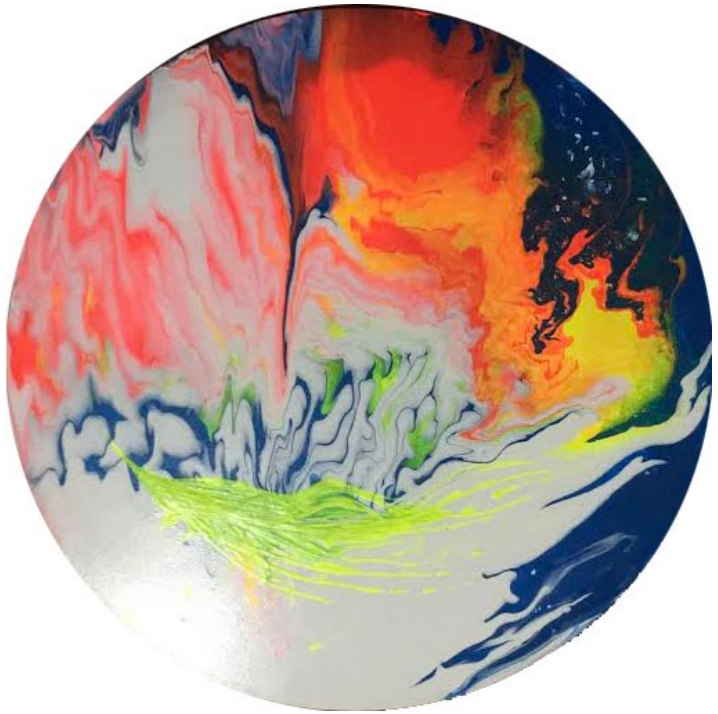
R1 Ouranos
R1 Ouranos
By Nicole Yazbeck Moussalli
In Artworks
Couldn't load pickup availability
Stock level: 1 left
Item details:
▸ Features: Handmade Unique Piece▸ Materials: Canvas
▸ Art technique: Acrylic Painting
▸ Dimensions (cm): 70.0 x 70.0 x 2.0
▸ Net Weight (kg): 5.0
In her series Ailleurs, Nicole Yazbeck Moussalli creates a constellation of circular and oval works inspired by celestial bodies, mythology, air, water, and the invisible movements that shape life. The collection draws on ancient Greek and Roman names for planets and satellites, many of which derive from gods and goddesses: Ouranos, Luna, Helios, Hermes, Poseidon, Cronos, Aphrodite, Ares, Gaia, Demeter, Zeus, Artemis, Hades, and Uranus.
Nicole’s artistic journey began with a deep sensitivity to nature. Her earliest sketches were inspired by flowers and fruits, which she transformed through colour, imagination, and a sense of fantasy. More recently, her work has turned toward two essential elements of life: air and water. Using fluid acrylic techniques, she translates their random, organic movements into captivating compositions in which the boundary between abstraction and illusion is very thin.
The works in Ailleurs are marked by movement, colour, flow, and transformation. Their circular forms evoke planets, inner landscapes, floating worlds, and imagined territories. Through the unpredictable behaviour of fluid acrylic, Nicole allows the material to become part of the creative process, producing surfaces that seem at once cosmic, aquatic, mineral, and atmospheric.
The collection includes works such as Ouranos, Luna, Helios, Hermes, Poseidon, Cronos, Aphrodite, Ares, Gaia, Demeter, Zeus, Artemis, Hades, and Uranus, mostly created in 2019 using acrylic on canvas or cardboard, with some works incorporating liquid crystal.
Curator’s Note
Dr. Pamela Chrabieh
Co-founder and CEO of Kulturnest
For Havens, we selected six works from Nicole Yazbeck Moussalli’s Ailleurs series: Ouranos, Poseidon, Helios, Gaia, Demeter 2, and Hermes. Together, they form a poetic constellation of elemental, mythological, and inner shelters, opening a dialogue with the exhibition’s central question: what shelters us, even briefly, when everything around us is unstable?
Nicole’s works are rooted in movement, colour, and transformation. Created through fluid acrylic techniques, they translate the unpredictable behaviour of air and water into abstract compositions where the line between illusion and abstraction remains deliberately fragile. This fragility is essential to their relation to Havens: they do not represent refuge as something fixed or closed, but as something fluid, temporary, and constantly reshaped by memory, emotion, and imagination.
Each selected work carries a symbolic resonance. Ouranos, named after the god of the starry sky, evokes the vastness above us: the cosmic shelter, the imagined horizon, the protective distance we sometimes need to breathe. It suggests a haven not as a room or a wall, but as an opening toward immensity.
Poseidon, linked to the god of seas and oceans, brings the symbolism of water: depth, movement, danger, cleansing, and renewal. In the context of Havens, water becomes both instability and protection. It reminds us that refuge can also be found in flow, in the capacity to adapt, and in the emotional currents that carry us through crisis.
Helios, associated with the sun, introduces light as a form of shelter. Light does not erase darkness, but it allows us to orient ourselves within it. Nicole’s Helios resonates with the exhibition’s understanding of havens as fragile gestures of hope, warmth, and visibility in times marked by exhaustion and uncertainty.
Gaia, the Earth, anchors the selection. It symbolises ground, origin, body, fertility, and belonging. Within Havens, Gaia speaks of the need to remain connected to what sustains us: land, roots, memory, and the living world. It reminds us that shelter is not only above or elsewhere; it is also beneath us, in the ground that holds our histories.
Demeter 2, connected to the goddess of agriculture, extends this earthly symbolism toward nourishment, care, cycles, and regeneration. It evokes the haven of cultivation: what we plant, protect, and patiently allow to grow, even in damaged landscapes. In a time of rupture, Demeter 2 becomes an image of continuity and quiet resistance.
Hermes, the messenger of the gods, brings the dimension of passage, communication, and connection. In Havens, this symbolism is particularly meaningful. A haven may be a message, a voice, a shared word, a bridge between isolated selves. Hermes reminds us that shelter can also be relational: the fragile thread that keeps us connected when separation, fear, or displacement threaten to fragment us.
Nicole’s biography deepens this reading. Her first artistic explorations emerged during the Lebanese war, when painting became a form of therapy and refuge from violence. This history gives Ailleurs a powerful resonance within Havens. The “elsewhere” she creates is not an escape from reality, but an inner territory where life can continue to move, breathe, and transform.
Through Ouranos, Poseidon, Helios, Gaia, Demeter 2, and Hermes, Nicole offers six possible havens: sky, water, light, earth, nourishment, and connection. Together, they invite us to imagine refuge not as withdrawal from the world, but as a way of remaining alive within it, through beauty, movement, memory, and the enduring human need to create meaning under pressure.
About Nicole Yazbeck Moussalli
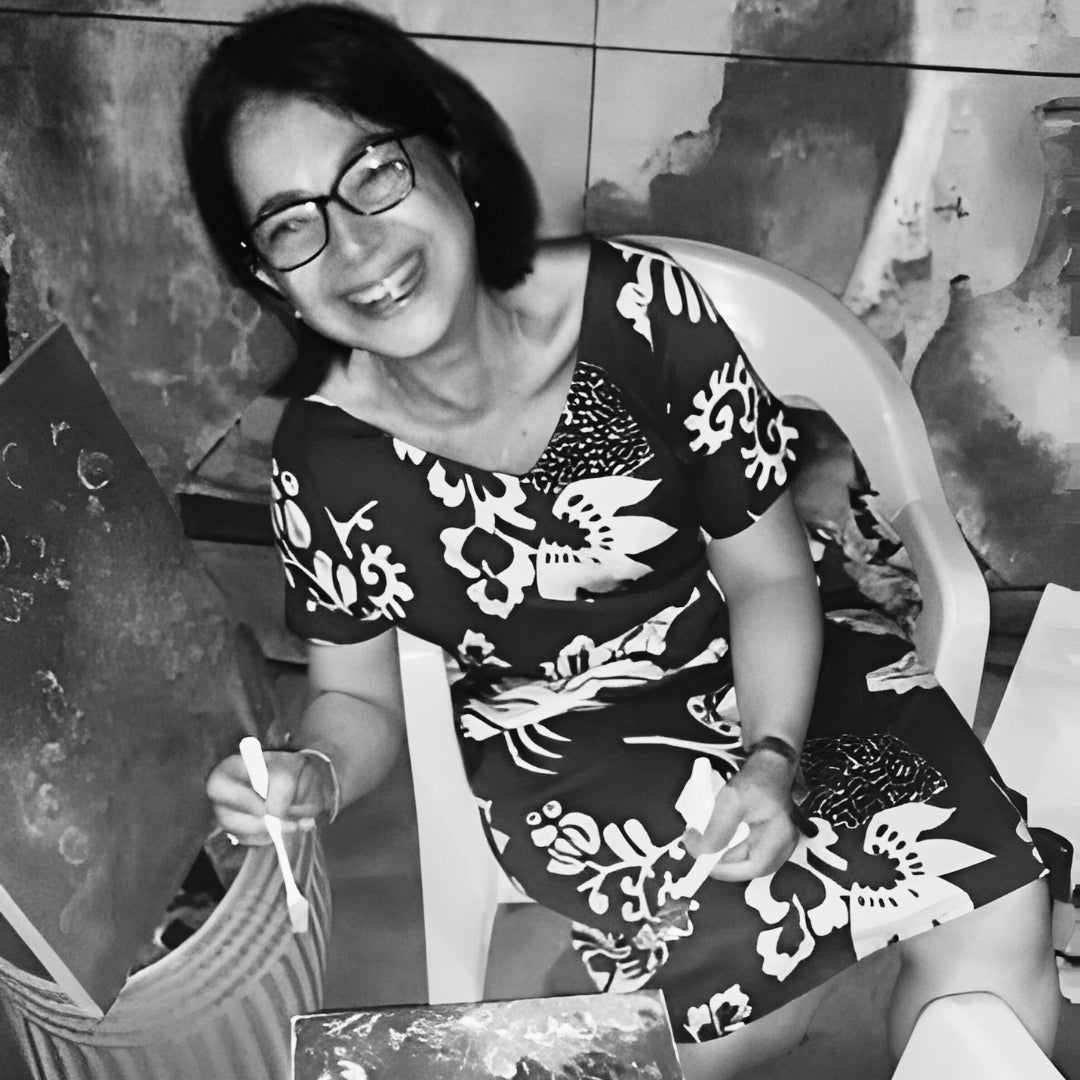
Born in Beirut, Lebanese national Nicole Yazbeck Moussalli is an interior architect and painter.
She graduated in 1990 from the National Institute of Fine Arts in Beirut. Drawn to the magic of colours, she developed a natural interest in drawing, her hidden talent. She chose to continue her studies at the same academy, refining her line, mastering pencil and charcoal drawing techniques, as well as acrylic and oil painting.
Her first sketches emerged during the war of the 1980s. Fleeing the horrors of conflict, she found therapy in painting and began working with glass. Her art, deeply rooted in reality, evolved and transformed into graffiti on sandbags placed at the entrance of a major restaurant as protection against shell fragments.
In 1982, her professor encouraged her to explore new media and commissioned her to create Chinese-style paintings on two lacquered wooden panels measuring 3.00 m x 1.50 m each, intended to frame a fireplace. The works were successful and led to further commissions, including decorative screens.
In 1985, one of these pieces was acquired by the Austrian cultural attaché in Lebanon, Mr. Christophe Turnwood.
Over the years, the artist continued to develop her craft, experimenting with various techniques: charcoal, oil, watercolour, acrylic, pouring, and wood engraving.
Her sensitivity to flora led her to elevate flowers by adding a touch of fantasy. Along her artistic journey, she questioned her roots and explored themes related to Lebanese folklore, such as the tarbouche, the cedar tree, the jar and the pitcher, and the Lebanese flag in motion.
Today, she continues to explore light and its variations, as well as the effects of chiaroscuro. More recently, she has drawn inspiration from two essential elements of life: air and water. Translating their random movement into her work, she creates captivating compositions where the boundary between abstraction and illusion is extremely fine. Her works are striking.
Several of her pieces are currently exhibited at Bekhazi Art Gallery, established in Beirut since 1935, as well as at Galerie Mojo and Sleepcomfort.
In January 2023, Nicole joined the community of artist-entrepreneurs of La Condamine.